

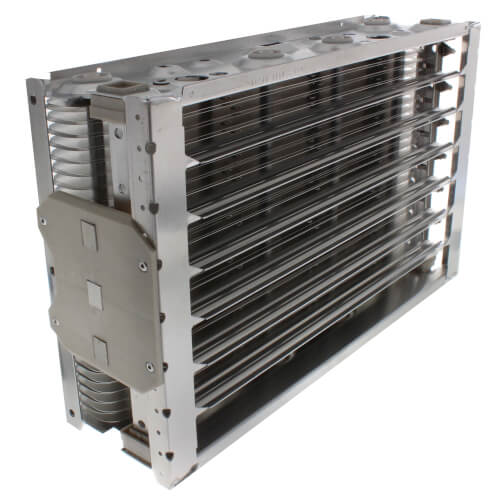
Electronic air cleaners are nothing new. They quietly remove microscopic particles from the air using an ionizing charge followed by attraction fins. Quietly at least until something bridges the gap enough to cause the familiar discharge snap. Either its cleaning time or a larger particle slipped past the pre-filter bridging collector fins. No one mentioned that each snap is a damaging arc weakening fins over time.
It isn’t just an annoying snap. The force of each arc is more significant than most people realize. Fins actually move during arcing. Movement is like a wave running down a fin that can result in resonance similar to the Tacoma bridge collapse.

Arcing is normally the result of particle bridging but over time, arcing weakens the metal structure of the fins allowing the force of the arc to move the fin. This force causes a ripple or wave action which may be the answer as to why cells arc repeatedly. The wave rolls across the affected fin bringing it closer to adjacent fins where it arcs again producing the all too familiar repeating snap.
Damage from arcing and general use eventually result in a misbehaving cell – expensive to repair and more so to replace. It doesn’t have to be if your willing to spend a little time. The solution is to stabilize the fins using something non-conductive. Unless a cell has been dropped or otherwise seriously damaged, there will only be one or two spots that arc.
An easy way to isolate and test suspected loose and arcing spots it stabilize them by folding thick paper or duct tape over the edge of the fin. Duct tape folded on itself removes the tacky side and it can then be folded again and placed over the edge of the suspect fin. It is thick enough to keep fins separated and also provided good electrical insulation. The cell can be re-inserted and tested to verify.
Folded paper or duct tape can be moved easily allowing repeated tests until the location that works best is determined. Using a camera inside the furnace to watch for arcs is another good method of locating the trouble spots which can then be verified with the aforementioned method.
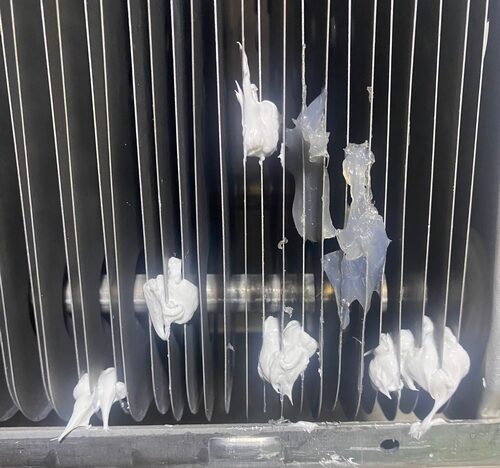
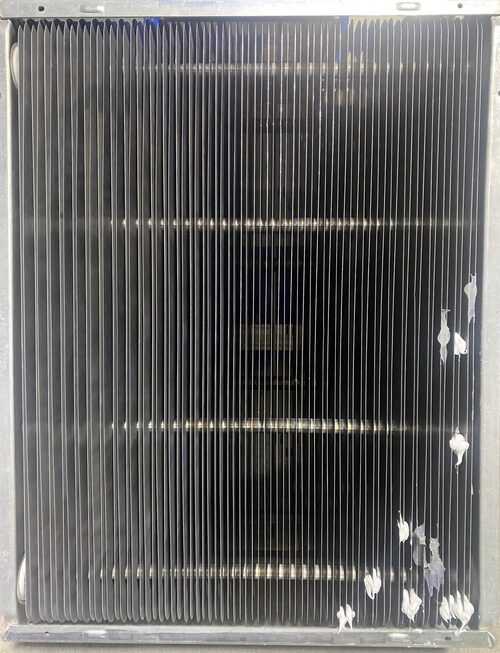
With troubled locations mapped, its time for something more permanent and washable. Surprisingly, your favorite caulking is likely a great candidate as long as its non conductive. It won’t be pretty, but once dry it maintains the fin spacing well and still allows for rinsing or washing. Although this method is not aesthetically pleasing, it is an effective and inexpensive repair that can add additional years of quiet service – worth the red-neck look.