


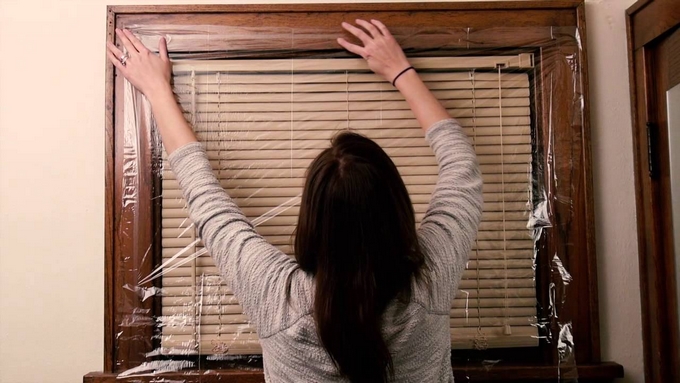
The age old plastic on windows during winter savings debate rages on each fall as the temperatures begin to dip. Claims of up to 50% savings on energy are easily found while more conservative estimates are between 5-15%. The number of variables involved make reasonable calculations rather difficult. Obviously higher savings would be obtained with poorer windows especially if air leakage is involved, but for most, air isn’t the issue. With rising costs and kits that now cost $15-20 for 3 smaller windows, is it really worth it?
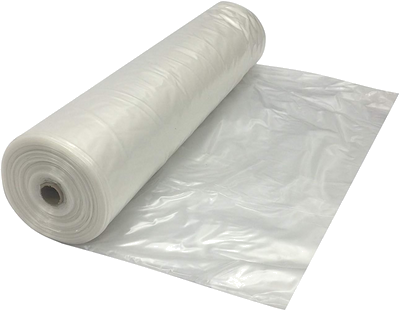
There are two ways to look at the numbers. One could be using such things as R value, BTU, and therm savings. The other approach is to use a reasonable percentage for estimated savings and calculate based on previous known costs. With estimated added R value of 1-2% it seems rather unlikely that energy savings would be anywhere close to claims of 50%. More realistic estimates are from 10-15% and that may also be high when compared to R values BTU savings.
So lets run through some numbers for kicks to get an idea of the value of plastic energy saving films. Since realistic numbers are from 5-15% for savings, we will use 10% for these basic calculations. Beginning with a smaller home of about 1100 sq feet with 10 windows (83 sq feet) and an older 80% efficient furnace we see the total annual gas cost is $1033. In fairness, however, we should be taking the basic fees out of equation as they do not change. In this case it’s about $29/m or $348 per year. We could just run with that, but to make it even more accurate, we should concern ourselves only with the winter months. Doing so results in a total cost of $607 for the 5 months of winter, subtracting $145 (5 X 29) for basic fees leaves us a base amount of $462.
At last we see that there is a potential savings of from $23.10 to $69.30, but for our calculations of 10% it will be $46.20. Window film kits range in price but can be purchased here for $15-20 at times for a kit that will do 3-4 windows. Assuming a mid-price of $17.50 and 3.5 window coverage per kit, we need 3 kits for a cost of $52.50 plus tax which is 11% or $58.28 total. Suddenly it is apparent we aren’t going to be saving much. Best case we would save $11.02 for the privilege of fighting with each window to put up plastic. These numbers seem to make sense in light of only a 1-2% R value increase for under 100 sq ft of wall.

Do the numbers change if get more complex and use BTU? As much as I would rather not do this, the numbers break down as follows. To calculate thermal loss in BTU we take the square footage of window area X temperature difference in F / R value with and without the plastic. So lets say the original R value of the windows is 3 while the temperature difference is 72-(-4)=76. We know our area to be 83 sq feet so (83 X 76)/3 = 2103. Adding plastic increases it by 1 to 2 R so (83 X 76)/4.5=1402. The difference is 2103-1402=701 BTU/hr assuming the temperature difference is constant over the 5 months, which it isn’t.
We know our 80% efficient furnace cost us $462 in gas for the winter. If we look up the cubic feet of gas used in those 5 months we see that it was 42801. To get BTU from that we multiply by 1037 which is 44384637 BTU. Since the savings are estimated at 701/hr we get 701*24*30*5=2523600 BTU. Before we go wow here, we need to check what percentage that is. So 2523600/44384637=.057 or 5.7%. In our original calculations we assumed 5-15% but we see here its only 5.7%. That is only $26.33 in savings.
This leaves us with the conclusion that it is not economically viable to purchase plastic for windows in an average home with at least dual pane sealed windows. If these numbers are true, we would be loosing money and increasing our frustration unless we could achieve a better than 14% savings. In the end it is still an individual choice but it does seem futile unless the windows are really bad.